

Agricultural projects,carried to operating condition.
Irrigation, storage and handling, fertilizer distribution and food-security programmes for governments, development institutions and private sponsors.
- Scope
- Feasibility to operation
- Counterparties
- Public and private
- Engagement
- Single mandate
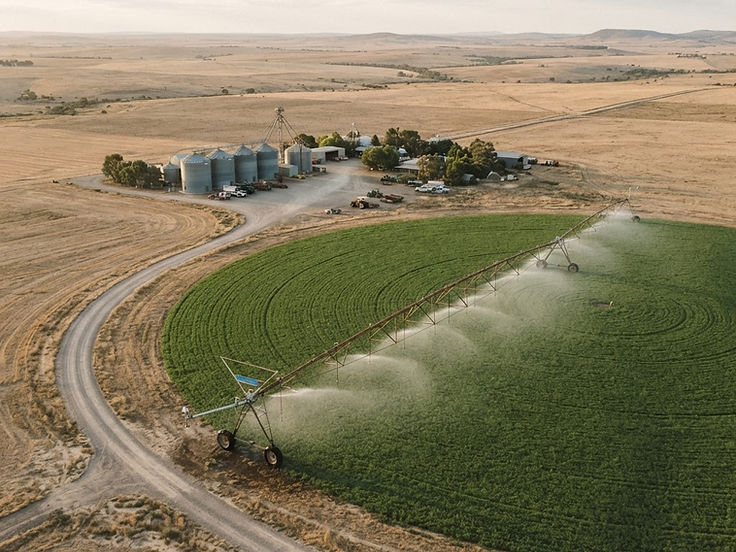 Irrigation · Storage
Projects are judged by what operates afterwards.
- Counterparties
- Ministries and state agencies, development finance institutions, agribusiness sponsors
- Scope
- Site assessment, capital structuring, EPC and equipment selection, PMO to commissioning
- Engagement
- Advisory through financing, or a full mandate to handover
An agricultural project is a sequence of decisions that are difficult to reverse: where it sits, how it is irrigated, how the product is stored, who operates it and against what specification. Most of the cost is committed before construction begins.
AQUAMERGE works on the sequence rather than the announcement. We test the site and the economics, structure the capital, select the engineering and equipment, and hold the programme to its cost, schedule and quality through commissioning.
Where a programme depends on fertilizer supply, the same mandate can hold the supply side — specification, contract and logistics — so the project is not financing an input it has not secured.
We tell you plainly whether the case holds. If it does not, we say so before capital is committed rather than after.
Four parts of the mandate.
Engaged separately or in sequence, with a single point of accountability across all four.
- 01
Feasibility and site assessment
Resource, water, soil, access and logistics assessed against the intended crop, output and market. Preliminary economics tested before design is fixed.
- 02
Capital structuring
Funding plan built around the revenue case, including development finance and export-credit participation where applicable.
- 03
EPC and equipment selection
Engineering, procurement and construction arrangements scoped and tendered, with equipment selected against operating requirements rather than catalogue claims.
- 04
PMO through commissioning
Governance across cost, schedule and change control, with reporting to sponsors and lenders and handover held to contract.
Five stages from mandate to handover.
- 01
Mandate
Objectives, sponsor structure, land position and the decision the mandate has to support.
- 02
Feasibility
Site, water, agronomy and logistics assessed; the case documented well enough to be financed.
- 03
Capital
Funding structure agreed with lenders and sponsors, with conditions understood before procurement.
- 04
Delivery
EPC and equipment contracted and managed, with cost, schedule and quality reported on a fixed cadence.
- 05
Operation
Commissioning, acceptance testing and handover to the operating entity, with documentation complete.
Where public support or sovereign participation is involved, the structure is agreed with the sponsoring institution before procurement begins.
Inputs for the programs we structure.
One team from the first site visit to the first harvest.
Feasibility that survives financing
The case is written to be examined by lenders and sponsors, not to support a decision already taken.
Delivery discipline
PMO governance across cost, schedule and change control, with commissioning held to the contractual specification.
Inputs considered with the project
Fertilizer supply can be secured under the same mandate, so the operating case does not rest on an unpriced input.
Counterparties screened
KYC and AML screening on contractors, suppliers and counterparties before contracts are executed.
Discuss a programme.
Tell us the jurisdiction, the intended output and the stage of the mandate. We will tell you whether the case is worth testing.