

Medical & MRI Equipment · Q3 2023 Sector Note · July 1, 2023
Closing the Diagnostic Gap: Pre-Owned MRI and CT as a Fast Path to Capacity
Refurbished MRI and CT systems are no longer a compromise. For clinics and hospitals facing long waits and stretched budgets, they are the fastest credible path to imaging capacity.
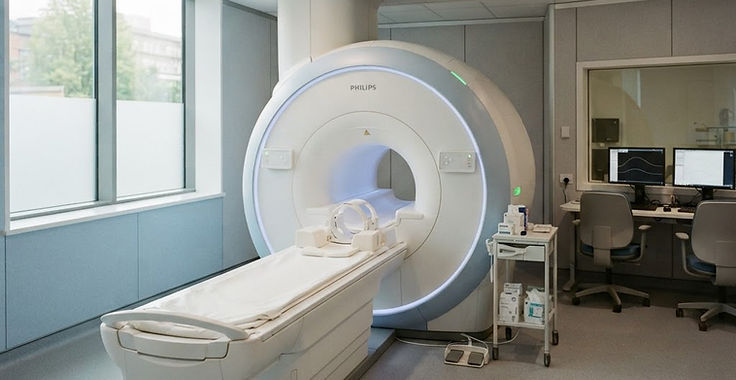
Diagnostic imaging has become one of the clearest bottlenecks in health care, in Canada and internationally. Demand for MRI and CT keeps rising, pandemic backlogs have not cleared, and new-system lead times and budgets are stretched. Professionally refurbished equipment is no longer a compromise option. For many clinics, hospitals and private operators, it is the fastest credible way to add capacity this year.
The size of the gap
Physicians surveyed at the end of 2022 reported that Canadian patients could expect a median wait of about 10.6 weeks for an MRI and 5.4 weeks for a CT scan, with some provinces at 12 to 20 weeks for MRI. The recommended maximum for semi-urgent cases is 30 days. Behind those averages sits an aging fleet: a substantial share of Canada's installed scanners are more than a decade old.
Policy is moving to meet the gap. In February 2023, Ottawa and the provinces agreed a new ten-year health funding framework with explicit priorities on backlogs and access. In May 2023, Ontario passed legislation to expand community surgical and diagnostic centres, including MRI and CT. Similar pressure is visible across the U.S., Europe, the Gulf and much of Asia and Africa, where capacity per capita is far lower still.
Why refurbished, and why now
- Time to scan. New systems can carry long lead times once tendering, manufacturing and installation are counted. A refurbished system that is already in inventory can be de-installed, reconditioned, shipped and calibrated in a fraction of that time.
- Capital efficiency. Refurbished MRI and CT systems typically cost a substantial fraction less than new equivalents. For a new imaging centre, that difference can decide whether the business case works at all.
- Proven platforms. Mid-life systems from major manufacturers have long clinical track records, established service ecosystems and widely available parts.
- Capacity where it is needed. Rural hospitals, private clinics and emerging markets often need reliable 1.5T MRI and multi-slice CT, not the newest research-grade platforms.
The helium factor
One operational risk now deserves a line in every MRI business case: helium. A conventional superconducting MRI magnet holds roughly 1,500–1,700 litres of liquid helium, and the world has been through repeated helium shortages, with supply disrupted by plant outages and geopolitics in 2022. Prices have risen sharply. Sealed-magnet designs now on the market operate with only a few litres of helium permanently enclosed, and nearly 600 such units were installed worldwide by late 2022. Buyers of any MRI, new or refurbished, should ask about helium consumption, boil-off rates, refill logistics and quench recovery costs.
What this means for clients
- Buy on documentation, not photographs. Ask for service history, coil inventory, software versions and the de-installation and refurbishment record. A system is only as good as its paper trail.
- Plan the site before the system. Shielding, power, cooling, floor loading and rigging access often determine cost and schedule more than the scanner price itself.
- Confirm regulatory pathways early. Medical device licensing, import rules and provincial or national approvals vary by market. Build them into the timeline from the start.
- Price the full lifecycle. Service contracts, parts availability, helium and software support matter as much as the purchase price.
Aquamerge supplies professionally refurbished MRI, CT, ultrasound and other imaging systems to hospitals, clinics and distributors, with support on sourcing, logistics and installation coordination. Our current equipment list is available on request.
Sources: Canadian Journal of Health Technologies (CADTH), imaging wait-time review (2023); Philips, "Leading the charge in making a change" (Nov 2022); Fierce Biotech, "With gas shortages looming, Philips inks magnet research pact" (2022).
Published by AQUAMERGE INC. for general information only. Figures, counterparties and commercial terms are disclosed only under NDA.