

Energy & Infrastructure · Q3 2024 Sector Note · July 1, 2024
Power First: Why Grid Access Now Decides Where Data Centres Get Built
Forecasters now project U.S. data centre electricity use to double or more by 2030. The scarce input is no longer land or fibre. It is firm, connected electricity.

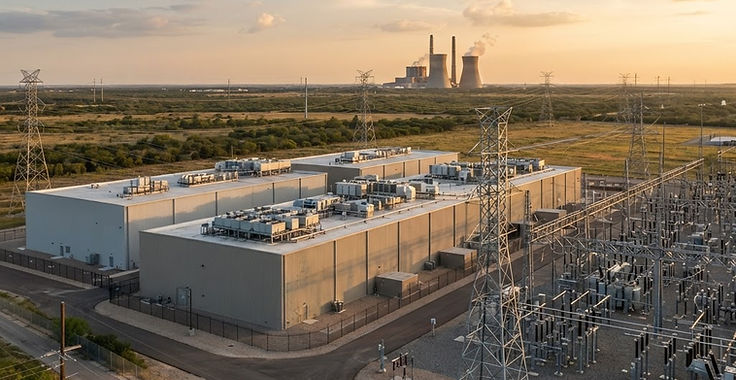
A year ago, we argued that generative AI would turn data centres into an energy story. The first half of 2024 has confirmed it faster than expected. Major forecasters now project U.S. data centre electricity use to double or more by 2030, and the largest technology companies are signing power deals that look more like utility contracts than real estate leases. The scarce input is no longer land or fibre. It is firm, connected electricity.
The forecasts have moved
In late May, the Electric Power Research Institute estimated that data centres could consume between roughly 4.6% and 9.1% of U.S. electricity generation by 2030, up from about 4% today. Goldman Sachs Research projects a 160% increase in data centre power demand by 2030 and estimates U.S. utilities will need around US$50 billion of new generation capacity for data centres alone. After nearly two decades of flat U.S. electricity demand, utilities are revising load forecasts sharply upward.
Hyperscalers go to the source
The clearest signal came in March, when a cloud provider acquired a data centre campus next to the 2.5-gigawatt Susquehanna nuclear station in Pennsylvania for US$650 million. The campus can scale to 960 megawatts, supplied directly by the plant under a long-term power purchase agreement, with commitments ramping up in 120 MW steps. The lesson for the market: the most valuable data centre sites are now those with assured, around-the-clock power already in place.
Other large buyers are signing multi-gigawatt renewable supply agreements and exploring small modular reactors. Grid connection queues in established hubs stretch for years, and utilities in several U.S. states are asking large-load customers for financial commitments before they build.
The new site-selection hierarchy
- 1Firm power availability. How many megawatts can be energized, and when.
- 2Power cost and price certainty. Long-term contracted pricing beats exposure to volatile wholesale markets.
- 3Carbon profile. Hyperscalers have aggressive clean-energy targets; low-carbon supply is often a requirement, not a preference.
- 4Climate and water. Cooler climates cut cooling energy; water availability matters for evaporative systems.
- 5Fibre, land, permitting and incentives. Still important, but rarely decisive on their own.
Canada's opening — and its limits
Canada scores well on several of these criteria: a cold climate, large low-carbon hydro and nuclear fleets, political stability and proximity to U.S. markets. But hydro-rich provinces are guarding remaining capacity carefully for their own industrial and electrification needs, and most large blocks of new power will need new generation and transmission. Provinces with flexible markets and natural gas resources may move faster on large campuses, with options to add carbon capture or cleaner generation over time. The winners will be projects that bring their own power solution rather than waiting in the queue.
What this means for clients
- Landowners near generation hold a valuable asset. Sites close to existing power plants, substations or high-voltage lines are worth evaluating for data centre potential now.
- Generators should rethink their offtake. Long-term contracts with data centre operators can de-risk existing plants and finance new ones.
- Developers need an energy strategy, not just a site. Interconnection studies, behind-the-meter options, and phased energization plans belong at the front of the project.
- Investors should underwrite power risk explicitly. A data centre without a credible power path is a stranded asset in waiting.
Aquamerge advises on data centre and energy infrastructure projects — site and power strategy, partner identification, capital raising and project management — for clients in Canada and internationally.
Sources: EPRI, "Powering Intelligence" white paper (May 2024), via S&P Global and E&E News; Goldman Sachs Research, "AI is poised to drive 160% increase in data center power demand" (May 2024); S&P Global Market Intelligence, "Talen Energy sells Pa. datacenter campus to Amazon Web Services for $650M" (Mar 2024); Power Engineering, "AWS acquires data center campus connected to Susquehanna nuclear station" (Mar 2024).
Published by AQUAMERGE INC. for general information only. Figures, counterparties and commercial terms are disclosed only under NDA.