

Data Centres · Q2 2023 Sector Note · April 1, 2023
The Compute Rush: Why Generative AI Will Rewrite Data Centre Power Planning
Generative AI turned data centres into an energy story within five months. The binding constraint is no longer land or fibre but firm, connected electricity.
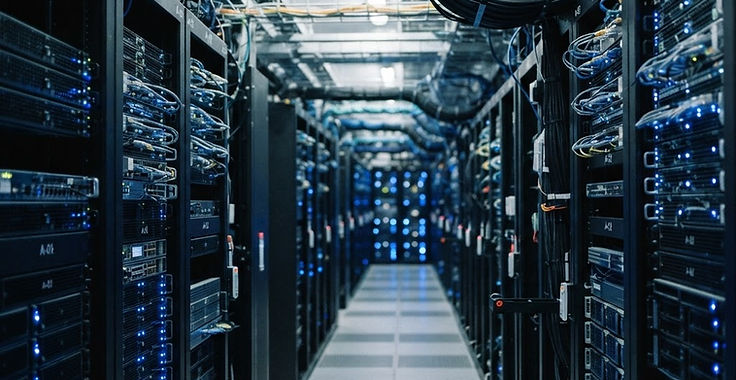
In the space of five months, generative AI has gone from a research curiosity to a boardroom priority. ChatGPT launched at the end of November 2022 and became the fastest-adopted consumer application on record; GPT-4 followed in March 2023. Most commentary is about what these models can do. Our view is that the more durable story is what they will demand: electricity, cooling and grid connections, in quantities that most data centre plans written before 2023 did not anticipate.
A different kind of load
Traditional enterprise and cloud racks have typically drawn somewhere in the range of 5–10 kilowatts. AI training clusters built on the latest accelerators are a different class of load. A single current-generation data centre GPU is rated at up to roughly 700 watts, servers carry eight of them, and racks of AI servers can run several times the density of a conventional rack. That changes everything downstream: power distribution, cooling (air cooling reaches its limits and liquid cooling moves from niche to necessity), floor loading and, above all, how much utility capacity a site needs.
Training is only the first wave. Once these models are embedded in search, office software and customer service, inference — running the models for billions of queries — becomes a continuous, growing load rather than a one-time project.
The grid was already the constraint
AI arrives in markets that were already short of power. In July 2022, the utility serving Northern Virginia's "Data Center Alley", the largest data centre market in the world, told developers that power for some new facilities in eastern Loudoun County could be delayed for years because transmission infrastructure had not kept pace. Industry estimates put more than 1.5 gigawatts of planned capacity in the affected pipeline, compared with roughly 1.9 GW then operating across Northern Virginia. Relief depends on new 500 kV transmission lines expected around 2026.
Ireland offers a second warning. Data centres consumed about 14% of the country's metered electricity in 2021, up from 5% in 2015, and Dublin-area grid operators have effectively paused new large data centre connections for years. These constraints were set before generative AI added a new layer of demand.
Where this leads
We expect four shifts over the next three to five years:
- 1Power becomes the site-selection criterion. Fibre, land and tax incentives still matter, but access to firm, large-scale electricity will decide where capacity gets built.
- 2New geographies win. Regions with surplus generation, cold climates and available land — including parts of Canada — become more competitive against traditional hubs.
- 3On-site and dedicated generation. Expect developers to pair campuses with dedicated generation, long-term power purchase agreements and, eventually, firm low-carbon sources such as nuclear.
- 4Infrastructure capital rotates. Investors who once valued data centres as real estate will increasingly value them as energy infrastructure, with matching timelines and risk profiles.
What this means for clients
- Secure power before land. For any data centre project, the utility interconnection study and capacity commitment should come first, not after site acquisition.
- Design for density. New builds should allow for high-density racks and liquid cooling, even if initial tenants do not need them. Retrofitting is far more expensive.
- Think in phases. Large campuses can be structured so the first phase energizes on available capacity while later phases follow grid upgrades or on-site generation.
- Model the energy cost, not just the build cost. Over a facility's life, electricity typically outweighs construction. Pricing and supply structure belong in the feasibility study from day one.
Aquamerge advises developers, investors and landowners on data centre and energy infrastructure projects, from early feasibility and power strategy through capital raising and project management.
Sources: Data Center Frontier, "Ashburn Power Crunch May Cause Delays in Data Center Construction" (Jul 2022) and "Dominion Resumes New Connections, But Loudoun Faces Lengthy Power Constraints" (2022); Bisnow, "'Unprecedented Times': A Power Shortage in Data Center Alley" (2022); Central Statistics Office Ireland, Data Centres Metered Electricity Consumption 2021.
Published by AQUAMERGE INC. for general information only. Figures, counterparties and commercial terms are disclosed only under NDA.